Kimchi is the food. Kimjang is the practice.
UNESCO inscribed “Kimjang, making and sharing kimchi in the Republic of Korea” on its Representative List of the Intangible Cultural Heritage of Humanity in 2013. Its record does not treat a jar, recipe, or ingredient as the heritage element. It describes a collective practice in which communities prepare and share large quantities of kimchi before winter, linking food preservation to cooperation, seasonal knowledge, and family life. Kimjang therefore names an activity and a social relationship, not merely a side dish.UNESCO · Kimjang record
Korea Tourism Organization material supplied by the Korea Heritage Service makes the same distinction in practical terms. It describes kimjang as preparing and sharing large quantities of kimchi for winter while emphasizing cooperation, exchange, and ties among people. A visitor does not need to decide whether one restaurant’s kimchi is “the real thing” in order to understand the tradition. A better question is: what work, timing, knowledge, and sharing sit behind the food in this particular story?VisitKorea · Korea Heritage Service overview
The Korea Heritage Agency’s English K-Heritage publication is structured around the same reader question. Its first part separates “Kimchi and Kimjang,” asks “What is Kimjang?”, then moves through early-winter ritual, flavour, family transmission, history, ethnography, contemporary practice, diaspora stories, recipes, storage, and tools. That structure is useful evidence that a food and the social practice around it require different explanations.Korea Heritage Agency · Kimjang publication
The distinction also helps with language. You can say that you ate kimchi, bought kimchi, or learned a kimchi recipe. Use kimjang more carefully for the seasonal making-and-sharing practice itself. You may also see the spelling gimjang; it refers to the same Korean term. Precision is not a test imposed on visitors. It is a way of leaving room for the people whose family, neighbourhood, workplace, charity group, or local organization gives the word its lived meaning.
A winter food begins long before winter.
UNESCO’s description gives kimjang a yearly rhythm rather than a single autumn afternoon. It records preparations that may begin with obtaining and salting seafood in spring, acquiring salt for brine in summer, drying and grinding red peppers in late summer, and making kimchi together in late autumn. The exact sequence should not be treated as a mandatory schedule for every household now. Its value is explanatory: the practice connects a winter table to earlier decisions about ingredients, weather, labour, storage, and timing.UNESCO · Kimjang seasonal cycle
VisitKorea’s English digital heritage book gives the same historical sequence and describes late autumn as the point when a suitable day was selected and people could gather. It also shows that kimjang has been represented through storage vessels, seasonal duties, and several kinds of kimchi rather than one instantaneous recipe. The book contains nutrition language that this magazine does not adopt as personal health advice; its value here is the cultural calendar and material record.VisitKorea · UNESCO heritage digital book
For a reader planning a visit, the practical result is modest. Do not assume that any autumn date will offer a public kimjang programme, or that an event seen in an old video is still operating. If a current class or market appears, verify the exact organizer, date, language, ingredients, participation rules, and whether it is a demonstration, a small cooking session, a communal making day, or simply a sales market. Those are different experiences with different responsibilities.
CHOOSE YOUR NEXT QUESTION
Continue through the issue
Variation is the point, not a problem to solve.
UNESCO notes regional differences in kimjang and describes particular methods and ingredients as important family heritage. Its record also notes that skills and ideas are shared and accumulated through exchanges among households. This is strong evidence against the online habit of presenting one ingredient list as the only authentic version. A useful cultural account can name examples when a source supports them, but it should not turn cabbage, seafood, seasoning, or storage method into a universal rule.UNESCO · Regional and household variation
A VisitKorea seasonal-food guide gives a visitor-facing illustration of that variety by describing regional examples such as Yeosu mustard-leaf kimchi, Suncheon bitter-lettuce kimchi, and Seosan garlic-scape kimchi. The page’s event dates belong to 2025 and must not be reused as current travel information. Its durable value is narrower: local ingredients and methods can shape what people call kimchi, so “Which version is this?” is a better question than “Is this the one true version?”VisitKorea · 2025 regional kimchi context
Korea.net’s current information entry describes napa cabbage and radish with several common seasonings, then explains the shared labour and winter-preparation context. Read that list as an orientation to a documented form, not a universal recipe. The entry also says large-scale household kimjang has declined with apartment living and smaller family units while community and organizational events continue. It gives one account of change, not a census of what every Korean household does in 2026.Korea.net · Kimjang culture entry
The question works in a kitchen, at a market, or beside a package label. If a host offers a story about a household method, listen before comparing it to a viral recipe. If a seller lists ingredients you do not recognize, ask what they are rather than assuming familiar English labels capture the same food. Variation is not evidence that one household is doing kimjang incorrectly. It is part of the reason the practice carries memory across places and generations.
The culture is also the labour you do not see in a jar.
UNESCO describes kimjang as a collective practice that strengthens family cooperation and connects communities with seasonal conditions. VisitKorea’s Korea Heritage Service text likewise emphasizes people coming together, cooperation, and sharing. These records support a cultural claim about collaborative work; they do not support the flatter claim that every Korean family currently makes kimchi in the same way, at the same scale, or every year.UNESCO · Collective practice VisitKorea · Cooperation and sharing
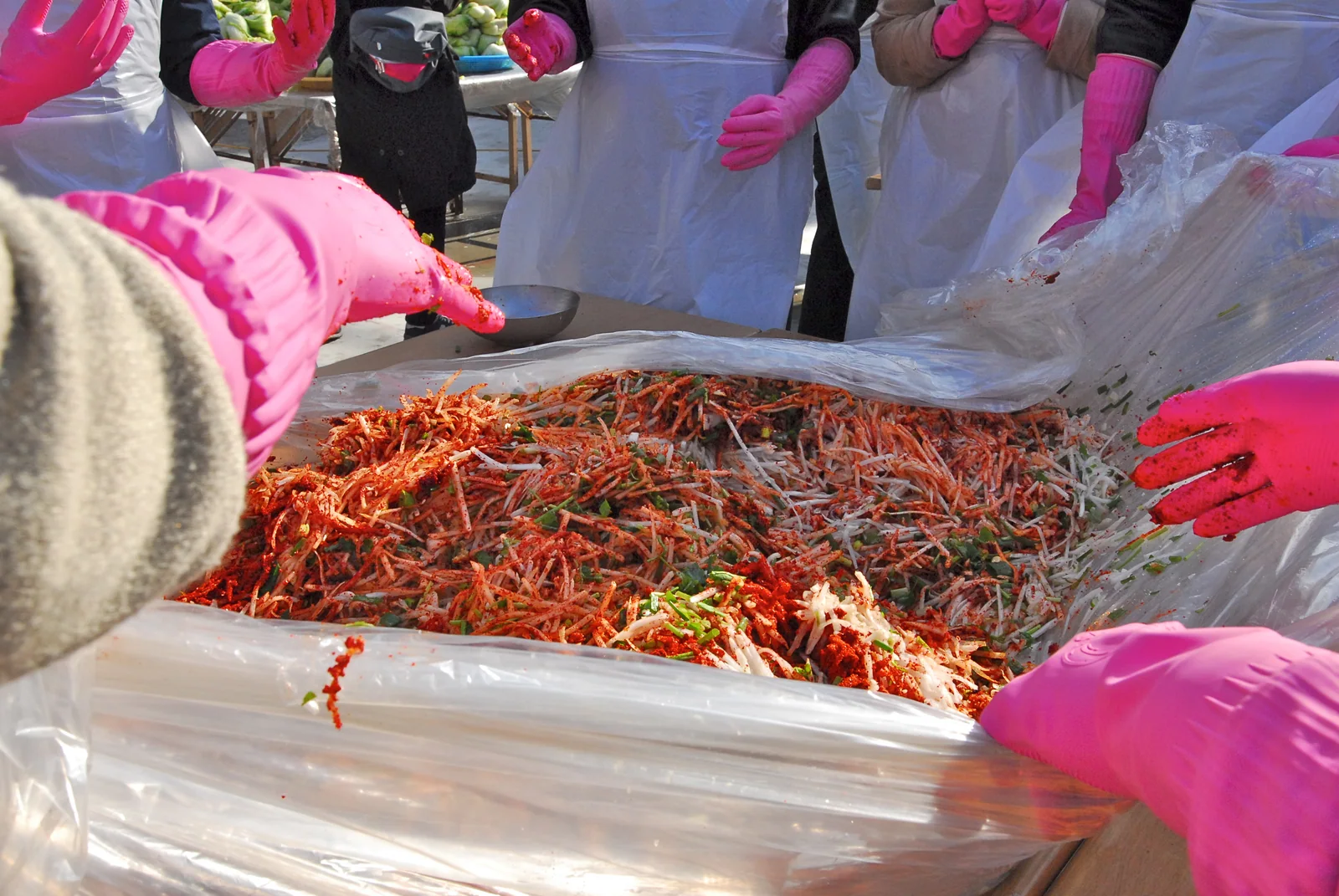
The visual shorthand for kimjang is often a table of bright seasoning and cabbage leaves. The fuller picture includes deciding quantities, collecting ingredients, salting, rinsing, mixing, filling, packing, carrying, cleaning, storing, and deciding where the finished food will go. Some tasks are repetitive; some require learned judgement; some are simply the work that makes the gathering possible. Seeing this does not require romanticizing labour. It means acknowledging that a tradition is made by people, not by a colour palette.
If you are invited to help, choose the role you can actually perform: washing, carrying, packing, cleaning, listening, or following a demonstrated step. Ask before changing the sequence, filming hands, publishing a recipe, or treating another person’s kitchen as a content set. The respectful visitor is not the one who performs familiarity. It is the one who can follow instructions and recognize when the work belongs to someone else’s routine.
Sharing is part of the definition, not a decorative ending.
The UNESCO record places exchange inside the practice: skills and ideas circulate, households share kimchi, and preparation becomes an occasion for cooperation. The Korea Heritage Service summary similarly treats sharing with others as part of kimjang’s social meaning. A finished container is therefore not the only output. Time, labour, knowledge, and food can all move between people.UNESCO · Exchange among households VisitKorea · Social meaning of kimjang
Korea.net’s official entry says families, relatives, and neighbours traditionally gathered because the process required considerable time and labour, then exchanged finished kimchi. It also records adaptation through community and organizational sharing events. That is evidence of continuity and change in public description. It is not permission to say that every contemporary event reproduces a household practice or that every Korean person shares the same emotional relationship to kimjang.Korea.net · Labour, exchange, and adaptation
For a visitor, the most revealing question is often logistical: who planned the quantities, who prepared the seasoning, how is the food stored, and who will receive the finished containers? Those details show how a seasonal practice connects labour and care. They also keep the focus on people rather than reducing a communal tradition to a single ingredient or a photogenic red cabbage leaf.
UNESCO recognition is not a health certificate or an authenticity stamp.
The official Korea.net entry defines kimjang as preparing large quantities of kimchi for winter and notes its 2013 inscription on UNESCO’s Representative List. This recognition identifies cultural value in the practice of making and sharing. It does not certify the health effect of a fermented food, determine which commercial jar is best, or require every person of Korean heritage to participate in a particular way.Korea.net · Scope of the heritage entry
UNESCO’s own record focuses on identity, seasonal preparation, knowledge, and cooperation. It does not say that kimchi treats fatigue, digestive symptoms, infection, weight change, or any other condition. This boundary matters because health language travels easily around fermented food. A cultural article can explain why people value a food practice without converting that value into personal medical, nutrition, or body-management advice.UNESCO · Scope of the Kimjang inscription
The same boundary applies to a visitor’s choices. A food can be comforting, spicy, salty, unfamiliar, delicious, disappointing, vegetarian, seafood-based, homemade, or packaged. None of those descriptions tells you whether it suits an individual allergy, dietary restriction, medication plan, or health concern. When food matters to your body, the relevant evidence is the actual ingredient information and a qualified source of advice—not a heritage listing or a travel article.
Treat a class or museum as an introduction, not a shortcut to ownership.
VisitKorea’s guide to hands-on Korean food experiences uses a kimchi-making programme as one example of how visitors can learn about food culture. Crucially, the guide says its class details were written in December 2023 and may have changed, directing readers to check the centers before visiting. That disclaimer is the right model for any current recommendation: a tourism page may help you discover a format, but the organizer’s live information determines whether a session exists, what it includes, and whether it is suitable for you.VisitKorea · Hands-on Korean food experiences
Before paying for a current experience, ask eight plain questions. Who hosts it? What exactly will participants make? Which ingredients are used? What language is used for instruction? Is the event a demonstration, a class, or a shared production day? What happens to the finished food? What are the photography rules? What are the cancellation and accessibility conditions? The answers do not make a programme more or less authentic. They make the booking specific enough to evaluate.
A short workshop can still be worthwhile. It may teach a technique, give you vocabulary, or help you understand why bulk preparation differs from making one jar at home. Just describe it accurately afterward. “I took a kimchi-making class” is clear. “I experienced the whole kimjang tradition” can be too large a claim for a one-hour activity. The difference protects both the host’s culture and the reader’s trust.
A package can contain kimchi without containing the whole practice.
The World Institute of Kimchi, an annex of the Korea Food Research Institute, publishes English-language materials on kimchi and kimjang culture through its public site. Its library makes a useful next stop for a reader who wants more than a single social-media clip or recipe. Use institutional material to deepen context while keeping documented cultural information separate from personal taste, product marketing, and health claims.World Institute of Kimchi · English resources
The Korea Heritage Agency’s book record shows how broad the subject can be: family ritual, flavours, history, ethnography, contemporary practice, diaspora stories, recipes, storage, and tools. A purchased jar may express one producer’s ingredients and technique. It cannot by itself document all those relationships. Read the package as a food product and the heritage sources as records of a wider practice.Korea Heritage Agency · Book contents
The best outcome of a first encounter may be a smaller vocabulary and a better set of questions. What season is this story about? Who is doing the work? What varies by place or household? Where will the finished food be stored? Who is it being shared with? What does this particular host want visitors to understand? You may leave with a recipe, a purchased package, a photograph taken with permission, or no food at all. The encounter still has value if it made you notice the work and relationships behind the meal.
ISSUE COMPANION
Kimjang experience verification card
Use this before joining a current class, demonstration, market activity, or community event. A historic tourism page is not a live booking confirmation.
- 1. Current host
Record the organizer’s current official page, direct contact, and the exact programme name.
- 2. Date and format
Confirm whether this is a demonstration, small class, market activity, or communal making-and-sharing event.
- 3. Instruction language
Ask which language is used for the briefing, recipe steps, questions, and any translation support.
- 4. Ingredients
Request the current ingredient list and ask about any restriction or cross-contact that matters to you.
- 5. Participant role
Clarify whether you will observe, make a small batch, assist a host, or help prepare food for sharing.
- 6. Finished food
Confirm whether you take food home, whether storage guidance is provided, and whether carrying it onward is realistic.
- 7. Photography
Ask before recording people, recipes, household spaces, or the finished food for public posting.
- 8. Change conditions
Save the cancellation, lateness, accessibility, weather, minimum-participant, and contact conditions in writing.
EVIDENCE & EDITORIAL RECORD
How this story was made
Separates kimchi as food from kimjang as a seasonal shared practice, preserving household variation and replacing superfood shortcuts with an experience-verification card.
Firsthand scope: No household kimjang, class, museum programme, product, recipe, or health outcome was personally tested.
What we checked
- UNESCO inscribed “Kimjang, making and sharing kimchi in the Republic of Korea” in 2013.
- UNESCO records collective preparation, sharing, and regional and household variation rather than one mandatory recipe.
Verify before you use this guide
- Current class, museum, or event dates and participation terms.
- Actual ingredients, cross-contact, language, photography, and cancellation rules.
Review dates describe editorial work, not a venue visit or publication date. Read the sourcing and corrections policy →
READER INTEREST SIGNALS
What people are asking
These links helped us identify the question. They are not evidence for the factual claims in this article.
- YouTube: UNESCO’s Kimjang heritage film · Used to identify the visual and English-language questions that surround making and sharing kimchi; the film’s heritage record, not viewer reaction, supports factual claims.
- Reddit: a 2026 family kimjang post and reader questions · Used only to identify recurring questions about the difference between kimchi and kimjang and whether visitors can join an event; individual comments are not cultural or travel verification.
PRIMARY RECORDS
Records used in this guide
- UNESCO: Kimjang, making and sharing kimchi
- Korea Tourism Organization / Korea Heritage Service: Kimjang heritage information
- Korea Tourism Organization: UNESCO heritage digital book
- Korea Heritage Agency: Kimjang, Making and Sharing Kimchi publication
- Korea.net: Kimjang culture information entry
- World Institute of Kimchi: English cultural resources
- Korea Tourism Organization: regional kimchi context in 2025 seasonal-food reporting
- Korea Tourism Organization: hands-on Korean food experiences and change disclaimer