1. Start with one school and one date
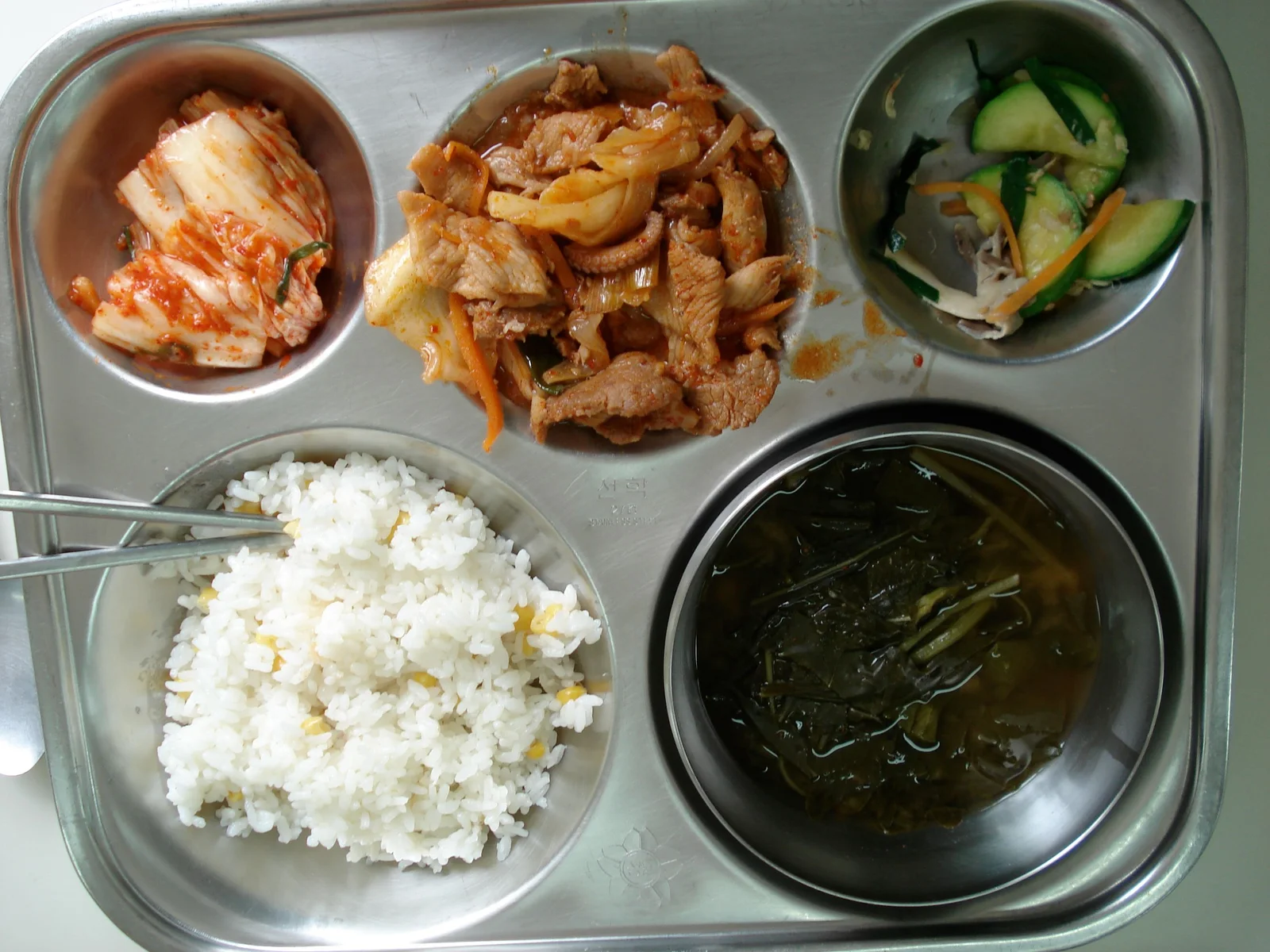
A neatly divided school-lunch tray can feel unfamiliar to an overseas viewer, especially when rice, soup, kimchi, and several other dishes appear at once. A short clip can make that first impression travel quickly; the photograph still records only one meal in one place. Begin with three details the image cannot supply on its own: the school, the service date, and the official menu. Those details turn a quick reaction into a record that can be checked.
Korea’s School Meals Act defines school meal services as meals provided by school principals to students in the covered schools and classes. The current law frames the service as part of education and places quality, nutrition, sanitation, safety, food-material management, and student food education inside the institutional picture. That is the first useful shift for an English reader: a school lunch is not only a meal image; it is a school-managed service with administrative and educational responsibilities.[1][2]
Start with the smallest true statement: “This is a menu from this school on this date.” Then ask what record accompanied it. If the post has no school name, no date, no official menu, and no explanation of substitutions, it may still be an interesting photograph. It is not a reliable guide to Korean school meals as a whole.
2. Use table vocabulary, not a national formula
The Korean Food Promotion Institute describes Korean food as a table culture in which rice, soup, and side dishes are considered in relation to one another. That frame helps an English reader recognise bap (rice), guk (soup), jjigae (a stew-like dish), banchan (side dishes), and kimchi as a family of fermented vegetable preparations when those names appear on a menu. A school may instead list bread, noodles, a one-bowl dish, fruit, dairy, or a special-event item. Use the vocabulary to read the record, then follow the related Korean-table guide below for the wider cultural context.[14]
Why can the tray look so composed? The current School Meals Act asks schools to build meals with a variety of foods, while the enforcement rule tells menu planners to consider traditional food culture, different food groups, seasonal and natural foods, and varied cooking methods. That framework can help explain the visible range on some trays. It does not prove that every tray is complete, identical, or appropriate for a particular student.[5][8]
On a school menu, keep the published Korean dish name beside any English gloss. A shortened translation such as “vegetables,” “soup,” or “meat” can hide the form of the dish, yet the name alone still does not provide a full ingredient list. Treat translation as orientation; use the school’s current allergen legend and notice for ingredient questions.
CHOOSE YOUR NEXT QUESTION
Continue through the issue
3. The meal is planned through a school system, not assembled for a camera
The public conversation around school meals becomes clearer when the kitchen is treated as an operating system. Menu planning connects to procurement, receiving, storage, washing, cooking, transport where applicable, distribution, dishwashing, and sanitation. That is less photogenic than a tray, but it explains why a school meal has rules and records behind it. It also prevents a reader from assuming that a neat tray means any particular kitchen practice has been independently verified.
The School Meals Act requires hygiene and safety management throughout menu planning, purchasing, inspection, storage, washing, cooking, transport, distribution, and utensil cleaning and disinfection. It also provides for nutrition management standards set by the Ministry of Education, with food-composition criteria that offices of education may determine where necessary. These are regulatory and management boundaries, not evidence that every meal is identical or that a reader can assess a school from a photo.[5][6]
This also explains local variation. National rules can set a framework while offices of education, schools, menus, procurement conditions, seasonal ingredients, kitchen capacity, calendars, and operational decisions affect the actual day. Do not describe a dish as “what Korean schools serve” when the honest wording is “what this school listed for this meal.”
4. Read the public menu beside the image
If you want to understand a tray, look for the menu record first. A date, school name, meal type, menu names, and notices make the image interpretable. Without them, rice may be mistaken for a universal staple requirement, a soup may be mistaken for an every-day feature, and one special menu may be misread as a standard service. Menu records let a reader separate the meal itself from the story built around it.
Food Safety Korea’s public school-meal menu service says that the information is provided by the Ministry of Education and lets people search by school; it also warns that a menu can change because of school circumstances. The Ministry of Education’s NEIS school-meal data service is described on the public data portal as a service built from education information supplied by metropolitan and provincial offices of education, with school menu, calorie, and allergy-related fields. These systems make a school-and-date check possible; they do not turn a public record into a personal dietary assessment.[11][10]
Use one fixed reading order. An illustrative record would be: School — [official school name]; service date — [YYYY-MM-DD]; meal type — [lunch, dinner, or another service]; menu — [dish names exactly as published]; allergen legend — [the publisher’s code-to-ingredient key]; change notice — [the school’s latest update]. The brackets are a field template, not a live menu or a fictional school recommendation. Match the first three fields before interpreting a dish name, then check the legend and any same-day notice.
The useful reading sequence is: identify the school and date; find the official menu; note whether the record says lunch or another meal; compare the photographed food with the published list; and keep any difference as a question rather than a conclusion. A substitution, a missing item, a serving-size difference, or a menu change can have routine operational causes. None is proof of a problem or an achievement without the school’s own current explanation.
5. Allergy information is a notice to check, not a safety verdict
An allergen marker beside a menu is valuable because it tells families and students where an ingredient question begins. It is not a guarantee that a dish is appropriate for a particular person, a statement about cross-contact controls, or a substitute for a school’s current guidance. A visitor should never infer that an unfamiliar menu is safe to eat simply because an allergen code appears—or does not appear—in a screenshot.
The current School Meals Act requires schools and school-meal providers to notify and mark foods that may cause allergies before service when those ingredients are used. The public NEIS meal-data listing includes allergy information among its school-meal fields, and the national school-meal platform includes menu and allergy-information sections. Together, these records support a narrow claim: allergen information is part of the public-information structure. They do not establish ingredients, substitutions, cross-contact, medical suitability, or the current policy of one school on one day.[7][10][12]
For a reader with an allergy, a dietary restriction, or a medical concern, the right endpoint is the school’s current nutrition or meal-service contact and an appropriate qualified professional where needed. This guide can explain what a menu record may contain. It cannot translate a dish name into an ingredient list, decide whether a substitution is suitable, or assess a personal risk.
6. If lunch is ‘free,’ who is paying?
A caption may describe a Korean school lunch as free. That word answers only one part of the question: whether a family is charged. It does not mean the food, staff, kitchen, utilities, transport, or administration have no cost. A useful explanation separates the amount paid by a household from the recorded cost of providing the meal.
The current School Meals Act separates operating responsibility, possible guardian-paid food costs, and public support. Article 8 provides the expense framework and allows food costs to be borne by guardians, while Article 9 allows the national or a local government to support all or part of school-meal expenses. The result cannot be reduced to “all Korean school lunches are free.” The applicable school, school level, locality, and school year still matter.[3][4]
SchoolInfo’s 2026 disclosure schedule includes school-meal implementation and school-meal expenditure categories. That is the practical clue: a meal can be free at the point of use for a family and still have a disclosed per-meal or programme cost. For a current answer, check the named school and the relevant education office rather than carrying a viral caption from one place or year into another.[13]
7. What a tray can tell you about education and culture
A school meal places familiar Korean food vocabulary inside a structured school day, where menu information, nutrition education, food-material management, and service routines meet. The tray becomes one meeting point between food culture, public education, and institutional work. Home meals, student preferences, and local food habits are different stories and need their own evidence.
The Ministry of Education published a 2026 “Data Reading Our Education” issue specifically about school meals, and the School Meal Integrated Platform publicly organises policy and operation, menus and recipes, nutrition management, hygiene, facilities, food materials, and nutrition education. These records show the range of work the public system tracks. A comparison with another country would require separate, like-for-like evidence.[9][12]
That perspective distinguishes this story from a Korean-diet article. The question here is not how a reader should eat, how to recreate a tray at home, or whether a meal changes a body. It is how an institution turns a menu into a school-day service, and how to read the menu without romanticising it or flattening its local variation.
8. Keep the record attached to the story
A school lunch tray is worth noticing because it makes a food system visible. The rice bowl, soup, sides, and labels can open questions about a Korean table, public education, menu data, school kitchens, and the everyday work required before a meal reaches a student. The story becomes more useful when it stays with those questions instead of converting surprise into a sweeping claim.
Use the School Lunch Tray Reader below before sharing or interpreting an image. It does not upload a menu, identify ingredients from a photo, calculate nutrition, assess allergies, search a live school record, or recommend food. It simply keeps the fields that a responsible reader would need in view: date, school, official menu, service changes, allergen notice, and the difference between a cultural observation and a universal claim.
ISSUE COMPANION
School Lunch Tray Reader
Use this browser-only reading card before you treat a school lunch image as evidence. It does not identify ingredients, assess nutrition or allergies, or verify a school’s current menu.
- School and date
Can you name the school, meal date, and whether the tray is lunch or another service?
- Official menu
Is there a school or public menu record that lists the meal, rather than only a photograph or repost?
- Table structure
Notice rice, soup or stew, banchan, kimchi, fruit, dairy, bread, noodles, or one-bowl dishes without treating any one item as universal.
- Changes
Does the record note a substitution, special event, supply change, or another reason the photo may differ from the published menu?
- Allergen notice
Use a current school record for an ingredient question; do not infer personal safety or cross-contact information from a menu label.
- Who pays
If a post says the meal is free, separate the family charge from the recorded meal cost and check the current local funding arrangement.
- Claim boundary
Describe what this school served on this date, not a uniform national system or a personal meal recommendation.
BROWSER-ONLY MENU READER
School Lunch Menu Reader
This private checklist does not collect a school name, date, dietary need, or any other personal information. It keeps selections only in this tab, does not save them beyond the tab or send them anywhere, and makes no nutrition, health, allergy, or food-safety judgment.
EVIDENCE & EDITORIAL RECORD
How this story was made
Reads one photographed tray through date-specific menu records, Korean table structure, public-information systems, funding, kitchen work, and allergen-notice boundaries without universalising a school or a country.
Firsthand scope: No school visit, meal observation, taste test, menu verification, kitchen inspection, allergy assessment, or representative survey is claimed.
What we checked
- The current School Meals Act frames school meals as a school-managed service and includes nutrition, sanitation, safety, allergen-notice, and food education responsibilities.
- Ministry of Education, Food Safety Korea, and NEIS public records expose date-and-school menu information while warning that menus can change.
- Korean Food Promotion Institute material describes rice, soup, and side dishes as an interrelated Korean table-culture frame rather than a universal tray formula.
- The current School Meals Act distinguishes possible guardian-paid food costs from full or partial national and local government support, so free to a family does not mean a meal has no recorded cost.
Verify before you use this guide
- The named school, date, meal type, official menu, substitutions, ingredients, portions, current service conditions, and any on-site notice.
- Allergen ingredients, cross-contact controls, substitutions, and individual dietary or medical questions with the school and an appropriate qualified professional.
Review dates describe editorial work, not a venue visit or publication date. Read the sourcing and corrections policy →
PRIMARY RECORDS
Records used in this guide
- [1] Korean National Law Information Center: current School Meals Act
- [2] Korea Legislation Research Institute: School Meals Act English translation reference
- [3] Korean National Law Information Center: School Meals Act Article 8
- [4] Korean National Law Information Center: School Meals Act Article 9
- [5] Korean National Law Information Center: School Meals Act Article 11
- [6] Korean National Law Information Center: School Meals Act Article 12
- [7] Korean National Law Information Center: School Meals Act Article 16
- [8] Korean National Law Information Center: School Meals Act Enforcement Rule Article 5
- [9] Ministry of Education: 2026 school-meal data issue
- [10] Ministry of Education / Public Data Portal: NEIS school-meal menu data
- [11] Food Safety Korea: public school-meal menu service
- [12] School Meal Integrated Platform: public school-meal information sections
- [13] SchoolInfo: 2026 school disclosure items
- [14] Korean Food Promotion Institute: Korean table culture