1. Why nail care appears in a K-Wellness Culture magazine
This magazine does not define Korean wellbeing as a checklist of beauty bookings. It asks how care becomes part of ordinary life. Nail care belongs only as a limited example of gwanri: periodic maintenance, a conversation with a practitioner, a choice about how to present yourself, and the right to decide what happens to your body and image. The value is not a before-and-after transformation. It is the literacy to understand a service, set a boundary, and leave without buying more than you intended.
That context also explains why this story is not a best-salon list. A visitor needs the same things a local client needs: the exact branch, service underneath the reference image, time, price, removal plan, language, consent, and a written change route. The rest of this guide keeps that small act of maintenance inside its proper scale rather than presenting nail art as the meaning of K-Wellness.
2. Start with the service underneath the photo
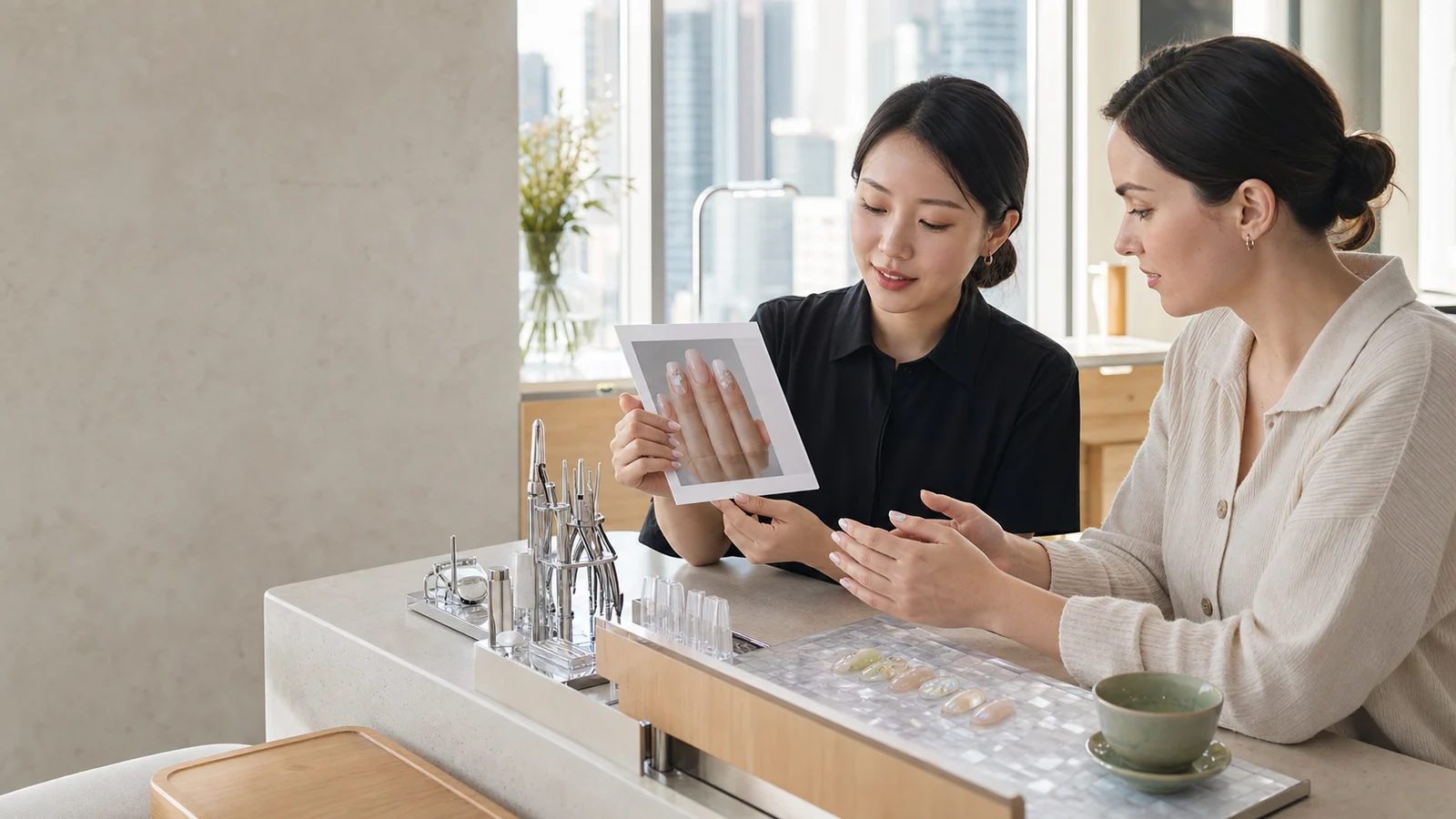
A nail reference image is a direction, not a complete service name. It may show bare nails, an existing gel base, removal from another salon, a short overlay, longer extensions, charms, hand-painted detail, chrome, a repair, or a shape that needs more time than the photograph reveals. Two images that look equally minimal can therefore create very different appointments. Before looking for a studio, write down what is currently on your nails and what must be removed, repaired, shortened, extended, or protected before the visible design begins.
Describe the request in layers: current condition; removal need; natural-nail or extension plan; target length and shape; colour or finish; art on how many nails; parts or three-dimensional detail; and whether you need a particular finish time. This is not about making the message fussy. It lets an operator say that the reference is possible, needs alteration, needs a longer slot, or should be booked as a different service. A clear no before payment is more useful than a beautiful portfolio image after it has set the wrong expectation.
OU Nail Hongdae's current public booking record specifically notes additional charges for gel removal and extensions. That is a useful reminder that removal and extension work are not safely assumed to be folded into a design menu. The record does not tell this magazine the exact quote, staff language, deposit, cancellation rule, or available artist for a reader's date, so those remain direct questions.[3]
If you do not know the technical term, plain language is enough: “I have gel from another salon,” “one nail is cracked,” “I want short rounded nails,” or “I would rather keep my natural length.” Add a current hand photo only if you are comfortable sending it and ask the operator whether it is enough to quote. Do not let an aesthetic booking message become a medical history. If you have pain, bleeding, swelling, signs of infection, a persistent skin or nail change, or another personal health concern, pause the beauty appointment and seek appropriate qualified advice.
CHOOSE YOUR NEXT QUESTION
Continue through the issue
3. An international-looking portfolio is not a language confirmation
A link hub, international audience, or English social caption can make a studio feel easy to book from abroad. That may be useful evidence that a contact route exists. It is not evidence that the receptionist, assigned artist, design consultation, service explanations, aftercare notes, change request, and payment conversation can all happen in English on your particular day. Ask about the whole appointment rather than asking a vague yes-or-no question about English.
Unistella publishes an official contact page and a link hub that points visitors to several contact routes, including WhatsApp, Facebook, and Kakao. The published routes establish ways to begin a message; they do not establish who can conduct the appointment in English, a specific booking policy, a price, deposit, or a confirmed slot. Treat the response to your dated request as the operative record.[2][1]
Use one complete sentence: “For this appointment, can the booking confirmation, consultation about this design, service explanations, and any aftercare notes be handled in English?” If a friend, translator, or message app will be involved, ask who is responsible for confirming the final service and terms. Save the answer with the branch, date, and artist name rather than treating a general profile description as a standing guarantee.
4. Put price, inclusions, and deposit in one written exchange
A posted “from” price, a design image, or an old message thread is not the final amount for a specific appointment. Ask the operator to state the total in KRW, the service sequence included, each likely additional charge, whether removal, repair, extensions, art, parts, length, or a different artist grade changes the total, and when the price can still change. If the studio cannot quote until it sees your nails in person, ask for the decision point and the right to decline before work outside the agreed scope begins.
Deposit terms need the same precision. Record the payment recipient, amount, currency, whether it is deducted from the final bill, the cancellation and rescheduling deadline, late-arrival handling, no-show rule, refund route, and the channel that accepts a change request. If the operator does not publish one of those details, the accurate status is not “free cancellation” or “non-refundable.” It is “ask before deposit.” K-Wellness does not collect payment, receive a commission, make an appointment, or decide whether an operator's terms apply to a reader.
Bandi in House's official franchise list identifies several branches, while Seoul Tourism's English record identifies the Gangnam-area Bandi Nail Apgujeong Branch and its published access context. Those records are helpful for distinguishing a brand from a physical branch. They do not confirm the nail menu, an English-speaking technician, price, deposit, or a booking for a particular branch and date.[5][4]
5. Choose a place record, then confirm the live terms
Korea Tourism Organization's public record for N. Olive Esthetic identifies the Times Square location and telephone contact. It is useful for place identity and a direct question route. It does not establish that a specific nail service, artist, language arrangement, appointment time, hygiene practice, price, or cancellation policy is currently available.[6]
Use the address as a planning anchor, not a guarantee of arrival ease. Confirm the exact floor, entrance, station exit, building access, check-in name, and contact method with the current operator. Allow enough time for a design consultation; only the operator can estimate the slot for your chosen work.
A supplemental Korea Tourism Organization record for Jenny House describes English and Chinese assistance at its Cheongdam salon context. The current salon-detail route must still be rechecked before use, so this guide does not treat the public listing as a current booking guarantee or use it to promise a nail service, price, staff member, or availability.[7]
6. Ask about tools and comfort without turning a salon into a clinic
A visitor can ask practical questions about the appointment: whether an artist can discuss fragrance, a product sensitivity you choose to mention, a preference not to cut cuticles, a wish to skip a particular technique, a need to avoid photography, or whether removal is planned. You can ask how shared tools and surfaces are handled between guests. A responsible operator should be able to explain its current process in plain language. This magazine has not inspected any salon or evaluated a hygiene practice, so it cannot certify a venue, product, procedure, or individual risk.
Keep the boundary clear. A cosmetic nail appointment is not a diagnosis, infection check, allergy assessment, treatment plan, or guarantee that a product will be comfortable for you. Do not use an appointment guide to decide whether to cover a painful nail, a rash, bleeding, swelling, unusual colour change, separation, or a suspected reaction. Stop and seek appropriate qualified medical advice when the question is about health rather than the design or booking.
Bring only what helps the booking. A short note can say, “Please do not photograph my hands,” “I have a fragrance preference,” “I want removal explained before it begins,” or “I need a quiet moment to decide on an add-on.” You do not owe an operator more personal information than is necessary to discuss the service. If a provider needs a health or safety decision beyond the ordinary salon scope, that is a reason to pause and use an appropriate professional route.
7. Make photography and portfolio use a separate consent question
Nail art is easy to photograph, and a studio may reasonably want to document a finished design. A booking reference, however, is not consent to marketing. Before your appointment, ask whether the studio plans to photograph or film hands, face, voice, process, before-and-after, payment area, or other guests; whether you can decline; where an image could appear; and whether a separate consent is requested for promotional use. A visitor can enjoy an appointment and still choose not to become content.
The same applies to your own reference images. Send only material you are comfortable sharing. Ask whether the image is used only to quote the appointment or may be kept in a client record. If the design involves another artist's work, say that it is inspiration rather than an instruction to copy a photograph exactly. An operator can offer a related interpretation, explain a limit, or refuse a request without making the booking unsuccessful.
8. Build one message that can survive a change of platform
A useful nail-booking message contains: the exact branch; your requested date and two time windows; the service underneath the design; current nail condition; removal, repair, or extension need; target length and shape; a reference image; language support needed; party size; total KRW quote and inclusions; expected duration and finish; deposit, cancellation, reschedule, and late-arrival terms; photo boundary; and the current payment recipient. It is a compact record, not a demand for a perfect prediction.
If the answer moves from a public contact page to Kakao, WhatsApp, direct message, phone, or a payment page, carry the written summary with it. Reconfirm the branch and date when a new person takes over. Do not send passport numbers, card numbers, travel booking codes, or health records through a beauty-booking chat unless a legitimate operator explains why a specific item is necessary and you are comfortable with the route.
For an adjacent Seoul beauty day, keep the categories separate. A hair appointment has its own service history and timing questions; a makeup lesson has its own practice and photo boundary; a personal-colour session is an aesthetic consultation, not a medical classification; shopping can happen without a booked service. The point is not to pack everything into one afternoon. It is to make each booking legible enough that you can choose, decline, or change it without losing the whole day.
ISSUE COMPANION
The Seoul Nail Appointment Record
Copy these ten fields into one message before a deposit. It does not choose a salon, send an inquiry, inspect a venue, store information, or make a reservation.
- 1. Branch
State the exact studio or branch, address, date, and two possible start times.
A brand page is not a branch confirmation. - 2. Current nails
Say whether you have bare nails, gel, removal from another salon, a repair, or extensions.
Ask what must be booked before the visible design. - 3. Shape and length
Name the target length and shape in plain language and attach one reference image if you choose.
A reference is direction, not an identical-result promise. - 4. Design scope
Ask how colour, art, chrome, parts, dimensional detail, or a change in length affects the appointment.
Keep uncertain add-ons in the quote question. - 5. English scope
Confirm booking, design consultation, service explanations, and aftercare for this date and artist.
An English page or social caption is not enough. - 6. Total quote
Request the total KRW price, inclusions, possible additions, and the point at which the quote may change.
Use “ask before deposit” if a field is missing. - 7. Timing
Record start, estimated duration, finish, and any time needed for a later fixed plan.
Only the operator can estimate a detailed design slot. - 8. Deposit and changes
Save recipient, amount, deduction, refund, reschedule, lateness, no-show, and change channel.
Do not borrow terms from a different branch or platform. - 9. Comfort boundary
Ask about any practical preference you choose to disclose and set a right to pause before an unagreed add-on.
Health concerns need an appropriate professional, not an editorial verdict. - 10. Photography
State yes or no for hands, face, process, voice, other guests, and marketing use.
A booking reference does not grant promotional consent.
FREE BEAUTY-DESK TOOL
Have a Korean package in front of you?
Paste the label text into our browser-only reader to find package fields, common product words, Korean functional-cosmetic wording, and claims that still need context.
EVIDENCE & EDITORIAL RECORD
How this story was made
Turns five public operator and tourism records into one ten-field nail-appointment record that keeps removal, extension, design, language, quote, timing, consent, and policy unknowns visible before a deposit.
Firsthand scope: No salon visit, booking, payment, artist-language test, hygiene audit, product test, service test, price test, or quality ranking is claimed.
What we checked
- The reviewed records identify Unistella contact routes, OU Nail Hongdae's message-booking record and disclosed removal or extension context, Bandi in House branch context, N. Olive Esthetic's Times Square identity, and a supplemental Jenny House language-context record.
- The records identify place and contact routes but do not establish a visitor's specific artist, English service, nail menu, price, deposit, cancellation condition, hygiene practice, or available appointment.
- The guide treats removal, extensions, design scope, and photography as appointment-specific questions rather than universal nail-salon facts.
Verify before you use this guide
- Exact branch, artist, booking, consultation and service-explanation language, design feasibility, removal, repair, extension, and current-nail service sequence.
- Total KRW quote, included work, possible additions, duration, finish time, deposit recipient, refund, reschedule, lateness, no-show, payment, and confirmation terms before payment.
- Photography, video, marketing use, products, comfort preferences, accessibility, and any personal health or safety question that applies on the day.
Review dates describe editorial work, not a venue visit or publication date. Read the sourcing and corrections policy →
PRIMARY RECORDS
Records used in this guide
The useful explanation and planning details are already on this page. These optional links are retained only so readers can inspect the underlying records.
Open the evidence links
- [1] Unistella: official contact routes
- [2] Unistella: official contact page
- [3] OU Nail Hongdae: official Kakao booking record
- [4] Seoul Tourism: Bandi Nail Apgujeong Branch
- [5] Bandi in House: official branch list
- [6] Korea Tourism Organization: N. Olive Esthetic
- [7] Korea Tourism Organization: Jenny House Cheongdam context